Showing posts with label Appeal. Show all posts

Thursday, 25 November 2010

Follow through and overlapping action

The principle of follow through and overlapping action is there to really bring forward the 'believability' of the characters movement.

The principle is dictated to by the laws of physics and follows them as much as it can; follow through demonstrates this the most with it being the law that as a character makes a movement, any loose items such as hair or an item of loose clothing will continue moving once that character has stopped due to the 'drag' on the item.

Overlapping action is simply a second action that runs at a different time alongside another action or movement. A good example of this is a walk cycle, where the arms are moving at a different time to the body and legs and therefore 'overlap' the action.

Examples:

Fig. 1
The simple follow through action of the hand continuing after the throw as it slows down displays the laws of physics and keeps the piece from becoming static, therefore making the whole action more realistic and enjoyable.


Fig. 2
Notice how the simple addition of the skirt to a bouncing ball gives it more meaning and sense of being. It adds more reference to the laws of physics by introducing the air resistance or 'drag' on the skirt and makes it more believable.


This short walk cycle demonstrates overlapping and secondary action in the characters movement.
Look how a simple standard walk is made more realistic with the simple addition of this principle; the overlapping action of the arms and follow through of the floppy ears give a real sense of weight to the character and show off his features.

Links:


Fig. 1 and 2: http://www.animationbrain.com/follow-through-overlapping-2d-animation-principle.html

Video: http://www.youtube.com/watch?v=ajagVS-M7b0

Sunday, 21 November 2010

Appeal - Research

Appeal is what helps animation characters seem "real" and interesting . It can be likened to "charisma" in an actor. Appeal is not restricted to sympathetic, beautiful characters, or protagonists; villains or monsters should have their own appeal too. The important thing is that the character has its own personality and the viewer is stimulated by it in some way, instead of bored. Appeal can rely on many aspects of animation - story, impressive visuals, sounds and character development, to name a few.

In characters that are intended to seem "good" or likeable, symmetry is often used. This is because we as viewers are often attracted to symmetry and idealised proportions, which make a character seem more "perfect" in our eyes. The same applies to the use of "baby-faces," as we tend to find babies innocent and cute, which adds likeability to a character when used. Disney and anime cartoons that makes use of the "super deformed" style, use of this cute, "baby-face" technique to make viewers feel more sympathetic towards the characters.
However, it is often considered unappealing to use something known as "twins" in an animation, meaning when both arms or legs are doing the same thing, creating a stiff, unnatural position that makes a character seem less "real." Introducing some "noise" to the geometry or design of a character can sometimes add to appeal.

Below: Super-deformed anime style makes characters seem more cute and "appealing" to the audience, as well as gives a more light-hearted, humorous take on emotions:

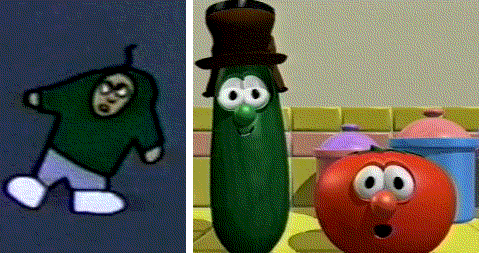
Lack of "solid drawing" often detracts from appeal, also. A strongly appealing character should have high quality design, drawing, modelling, poses and animation, expressed cleanly and clearly. Anything overly complicated and difficult to read, or clumsy and awkwardly moving lacks appeal to an audience.

Below: Example of a clumsy, unappealing character on the left, and strong but simple appealing characters on the right.

Below is a video I found explaining how to create appeal in a character's posing; although fairly technical I think this is quite helpful as the author talks through his thinking around the character's pose and how he is using it to display a certain emotion.


References
 Willian (2006). "Appeal" [Online] Blenderhttp://wiki.blender.org/index.php/Doc:Tutorials/Animation/BSoD/Principles_of_Animation/Principles/Appeal (accessed 21 Nov 2010)

"Appeal" [Online] http://www.evl.uic.edu/ralph/508S99/appeal.html (accessed 21 Nov 2010)